
Deciding Between Liquid and Air Cooling for Your Facility
As we navigate the era of AI and cloud services, the demand for robust cooling solutions has never been greater. Traditional air cooling is increasingly challenged by the need to maintain optimal temperatures for high-density racks. According to the Data Center Trends 2025 report by Vertiv, rack densities in AI-driven environments are projected to surge to as much as 500-1000kW. This trend not only calls for more power but also necessitates advanced cooling systems to prevent costly downtime caused by overheating equipment.
Understanding How Air and Liquid Cooling Work
In any data center, maintaining a stable environment is crucial for seamless operations. Equipment generates heat, which must be effectively dissipated to prevent system failures. Both air and liquid cooling methods achieve this, though through different mechanisms. Air cooling relies on air as a medium to transfer and remove heat from equipment, making it suitable for less dense settings. It employs precision cooling systems for varying scales—rack, row, or room cooling, capable of meeting diverse facility needs with solutions like the Liebert PDX Compact DX Cooling System or the Liebert® CW Chilled Water-cooling System.
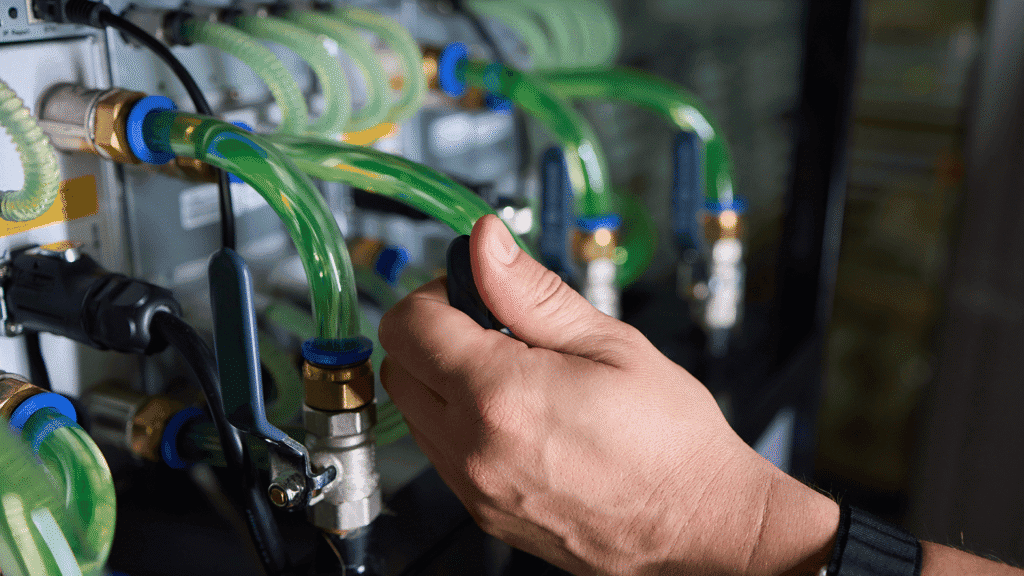
Conversely, liquid cooling employs water or specialized nonconductive liquids to directly absorb and dissipate heat, making it more suitable for high-density environments. This method includes several innovative approaches, such as:
- Direct-to-chip cooling: Involves directing coolant to the chips within your servers, exemplified by the Vertiv™ CoolChip CDU
- Rear door heat exchangers: Positioned at the back of server racks to extract emitted heat, as seen with the Liebert® DCD Water-Cooled Passive Rack Door
- Immersion cooling: Submerges entire servers in a nonconductive fluid that absorbs generated heat.
These liquid cooling techniques offer a more direct method of managing heat and can support higher rack densities than traditional air cooling.
Choosing the Optimal Cooling Solution
The decision on which cooling system to implement is largely contingent on your facility’s rack density. For lower density setups consuming under 20kW, air cooling is typically sufficient due to its capability to handle the comparatively lower heat and power demands. In these cases, systems like the Liebert DS Direct Expansion Cooling System can efficiently cycle cool air through your data center. High-density configurations, on the other hand, benefit significantly from liquid cooling, especially when power usage exceeds 20kW. As facility demands intensify beyond 30kW, liquid cooling becomes essential due to air’s limited thermal exchange capabilities.
To adapt to evolving technological needs, many facilities are adopting a hybrid cooling strategy. This method combines both air and liquid cooling to optimize efficiency and cost-effectiveness. For instance, the Vertiv™ CoolChip CDU integrates seamlessly into such systems by channeling liquid directly to chips while maintaining ambient room temperature through air conditioning. This synergy reduces energy usage by eliminating the need for compressors, thus optimizing power efficiency.
Stay informed on the latest advancements in cooling technologies by subscribing to our newsletter. For tailored advice, reach out to us directly at 704.364.8877 to discuss how JG Blackmon & Associates can help you maintain your facility’s ideal environment.
Frequently Asked Questions About Liquid Cooling
- What is liquid cooling? Liquid cooling involves using fluids to absorb and remove heat from high-density data centers, enhancing cooling efficiency.
- Why choose liquid cooling over air cooling? Liquid cooling is more effective for high-density environments due to its superior heat absorption and dissipation capabilities.
- Are there different methods of liquid cooling? Yes, including direct-to-chip cooling, rear door heat exchangers, and immersion cooling to suit various needs.
- When is a hybrid cooling approach recommended? Hybrid systems are ideal when facilities require both air and liquid cooling to efficiently manage diverse heat loads.
- How can I learn more about implementing liquid cooling? Contact JG Blackmon & Associates at 704.364.8877 for personalized advice and solutions.