

Enhancing Data Center Cooling: 4 Essential Steps
Balancing cost efficiency with environmental responsibility may seem challenging, but in data centers, you can achieve both simultaneously. As energy demands and costs escalate, effective data center cooling becomes increasingly vital. By adopting strategic practices, you can enhance your data center’s cooling performance and set the stage for sustained success.
Seal and Secure Your Data Center
Properly sealing your data center is crucial; it’s the cornerstone of a successful cooling strategy. Poor sealing can lead to cooling inefficiencies and increased humidity, both detrimental to your system’s performance. Consider these tactics to effectively seal your data center:
- Ensure doors remain closed consistently.
- Implement a vapor seal using materials like plastic film, vapor-retardant paint, and vinyl coverings for walls and floors. This is a cost-effective means of managing the environmental conditions of the data center.
- Seal all openings around pipes and cables entering through walls and flooring.
- Conduct a data center assessment to pinpoint and rectify inadequately sealed areas.
Implement a Hot-Aisle/Cold-Aisle Layout
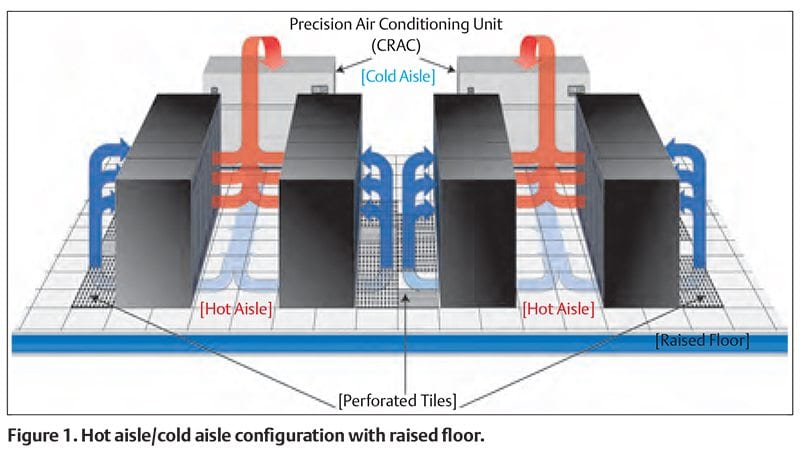 Optimizing airflow is the primary goal of hot-aisle/cold-aisle arrangements, which maximizes heat dissipation with minimal energy use. This setup enhances the performance of computer room precision air conditioning (CRAC) units, reducing their energy demand.
In this configuration, racks face each other, drawing cool air from the aisle, with heated air expelled into the hot aisle. CRAC units are positioned perpendicular to the hot aisles, thus raising the return air temperature and boosting efficiency.
Adopt Aisle Containment Strategies
After establishing a hot-aisle/cold-aisle system, the next step is to implement aisle containment to prevent the intermingling of hot and cold air. Containment involves sealing the aisle with overhead panels and creating barriers at each aisle end. This straightforward and economical solution is suitable even for raised-floor configurations.
Aisle containment significantly enhances data center cooling capacity by isolating hot and cold airflows, allowing for higher heat load management per rack. To explore more about Cold Aisle Containment, consult our white paper “Focused Cooling Using Cold Aisle Containment”.
Intelligent Cooling Management
Advanced control systems like the Liebert DSE high-efficiency cooling system are designed to optimize component performance, reducing energy use and offering diagnostic capabilities for data center management integration. The Liebert DSE achieves up to 70% greater efficiency than other technologies by using dynamic fan control, compressor modulation, and remote sensors for targeted energy distribution.
Liebert iCOM with Optimized Aisle Control allows independent operation of compressor and fan, aligning with IT load and airflow demands, ensuring efficient operation and avoiding unnecessary cooling.
We’re Here to Support Your Cooling Efficiency Goals
Given the growing demands on data center management, energy efficiency is a priority. Applying these strategies can significantly reduce your cooling energy use, aligning with organizational energy objectives.
At JG Blackmon & Associates, we’re committed to helping you design practical energy-saving plans. Many businesses can lower their energy usage with small adjustments and investments. Get in touch with your local Liebert partner to discuss making your data center operations greener!
FAQs on Data Center Cooling
- Why is data center sealing important? Sealing prevents inefficiencies and humidity intrusion, optimizing cooling performance.
- How does a hot-aisle/cold-aisle system improve cooling? It enhances airflow and reduces energy consumption by maximizing CRAC unit efficiency.
- What is aisle containment and its benefits? Aisle containment separates hot and cold airflows, increasing cooling capacity and efficiency.
- What role do intelligent control systems play? They optimize cooling operations, minimizing energy use and integrating with management systems.